Voices of Ascension ~ Grand Choral Opening/Haydn & Fauré
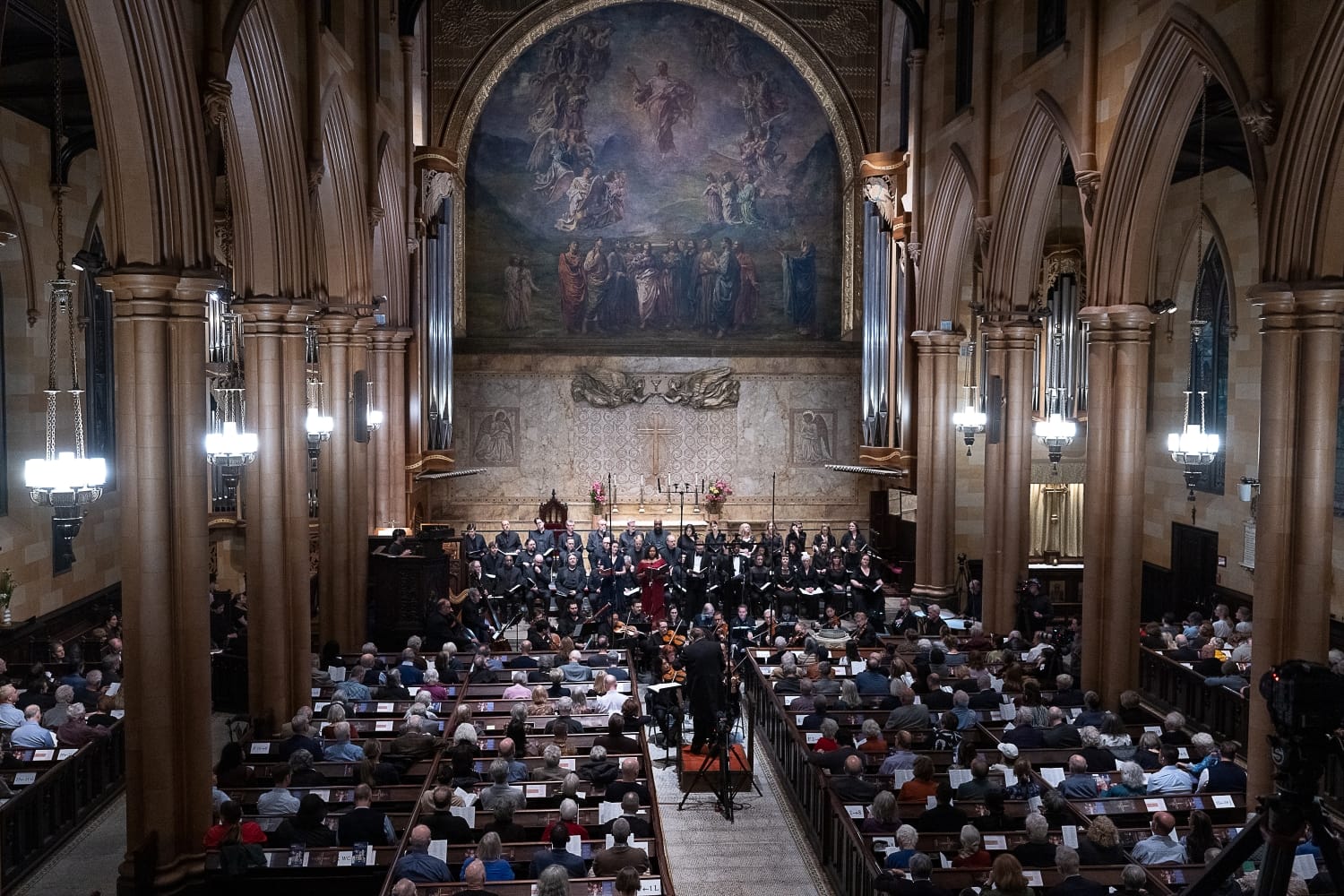
Photo: Christopher Duggan
Author: Kevin DallaSanta
Thursday October 29th, 2026 - With a “Grand Choral Opening”, Voices of Ascension presented a double feature at the Church of the Ascension: Haydn’s Mass in Time of War and Fauré’s Requiem.
The ambitious programming of two masses in the same concert—both in Latin with much overlapping text—relied on the musical contrast of two composers living a mere century apart, and the artistry of the musicians in maintaining dramatic tension. With a warm, gracious tone and excellent unity of ensemble, Voices of Ascension delivered the double feature to great success.
The choir formed in 1989 at the Church of the Ascension, in Greenwich Village, where the concert was held. The founding director, Dennis Keene, still conducts the ensemble, having retired earlier this year from his post as organist and choirmaster of the church. Thus their choral style hews closely, in the best sense, to that of a church choir, while performing actively at the professional level.
The architecture of the church interior has interesting ramifications on its acoustic. With a flat ceiling, narrow chancel, and broadly exposed side aisles, the sound of the ensemble was diffuse and warm, in contrast to the loftier, directional sound in more curvaceous churches. Voices were audible at every dynamic, and Voices of Ascension, with its lengthy experience in the space, often kept to a pleasant mezzo piano—the glowing, melded sonority of sacred ensembles.
In the first half, Voices of Ascension performed Haydn’s Mass in Time of War, known also as the Paukenmesse for the featured role of timpani. At first hearing, the C major mass sounds oddly cheerful given its title and its timing in Austrian history. Yet Haydn’s framing gives the work gravity: the Kyrie begins with a slow introduction ending on the dominant of C-minor, and the famous timpani motif in the closing Agnus Dei conveys the drums of battle.
The Amen of the Gloria, a highlight of the evening, brought an irrepressible joy, with voices chasing in scales before ending in unison. In a similar chase, both the Credo and the subsequent Sanctus use fugal textures to represent heaven, depicting a dazzling infinitude singing in praise. This auditory effect was underscored by the angels painted in the enormous mural at the front depicting Christ’s ascension.
As the March to the Scaffold draws audiences to Symphonie Fantastique, listeners aware of the Paukenmesse come to hear the Agnus Dei for its thrilling drama and timpani scoring. At “Dona nobis pacem,” the timpani and brass take off with gusto and the mass ends victoriously. The jubilant mood seems unusual for a plea for peace; yet perhaps Haydn realized that Austria’s peace would have to be won in battle, with some measure of divine assistance. The wartime setting would continue to inspire Haydn, as in his Nelson Mass written two years later.
The Latin texts of Haydn and Fauré were dispatched with excellent diction, particularly in the subtle emphases of text that distinguish sacred and secular choirs. Too often ensembles sing with word stress in their native language, but then deliver another language flatly, as though the words had no meaning. Even in Latin, intentional diction is key to a sense of authenticity.
Fauré’s Requiem, composed less than a hundred years later, begins not too dissimilar from Haydn, until the words “perpetual light” explode in lush Romantic chords of suspended seconds. The mass unfolding thereafter is a bubble bath of warm and luxurious harmonies, and one finds it hard to part with one movement for the next. Thankfully, Keene took relaxed tempi, and the acoustics favored savoring over speed.
The composer wrote that he viewed death as a “happy deliverance,” and his requiem mass seems to reflect his own limited religiosity. “Tartarus” and “the abyss” are contemplative, rather than frightening, and the Sanctus, with its beautiful accompaniment of harp and strings, floats in a trance of wonder.
“In Paradisum,” the final movement, is in a slow triple meter, with a gorgeous melody and harp-like accompaniment in the organ. The soprano line calls to mind the innocent voice of children, and indeed recordings such as the Choir of King’s College Cambridge are particularly compelling. Like the first mass on the program, the Requiem ends with a quiet peace.
Both works juxtaposed the choir with soloists, with performances by mezzo-soprano Lucia Bradford in the Haydn and baritone Joseph Parrish in the Fauré standing out. The conductor’s direction throughout was relaxed and pragmatic: clearly the rapport built over decades with the ensemble he founded has created a sense of trust and telepathy.
Furthermore, keen awareness of their natal venue’s acoustics supported the ensemble’s clarity and warmth. New York’s classical scene is often dominated by opera, ballet, and orchestral concerts uptown; yet a number choral ensembles, Voices of Ascension not least among them, are presenting interesting repertoire at a high level of artistry. Their current season will return to the requiem with the setting of Herbert Howells, and to the mass with Bach’s B-Minor setting.
~ Kevin DallaSanta