Jennifer Koh plays Bach's Sonatas and Partitas @ The Miller Theatre
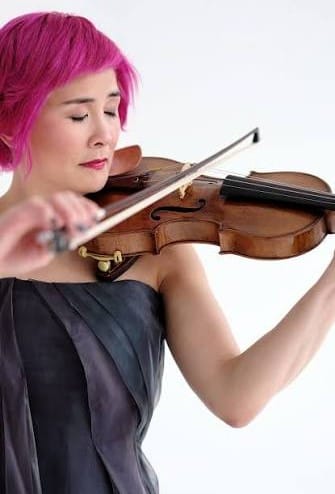
~ Author: Kevin DallaSanta
Thursday September 24, 2026 - Bach’s Sonatas and Partitas are a pinnacle of the violin repertoire. From their lofty heights, one has an unmatched panorama of the human experience. Climbing them, however, requires a great deal of technical ability, artistry, and endurance.
From the four strings of the instrument, Bach conjures an entire quartet through dense polyphonic writing. The effect requires tremendous control and subtle emphases to distinguish the different voices; any misstep and the illusion comes crashing down, leaving the music dull and mechanical. With nearly three hours for the six works, it is a great risk to perform all six for an audience.
Jennifer Koh is well aware of the challenge, having recorded them all in her series “Bach and Beyond”, and performed them extensively. Her recital, at Columbia’s Miller Theatre, was accompanied by her first public sharing, in a Times article, of her diagnosis of Parsonage–Turner Syndrome, a form of neuropathy. Her choice of timing underscored the works’ importance to her and the physical marathon of performing the complete cycle.
The six works, BWV 1001–1006, form a set with alternating sonatas and partitas. The first four are in the minor mode, concluding with the monumental Chaconne. The remaining two are in the major mode, including the Heiliger Geist fugue and the famous E major Preludio. They have inspired numerous transcriptions, from Bach’s own reuse of the E-major Preludio (twice, in separate cantatas) to Rachmaninoff’s arrangement of the third partita and innumerable renderings of the Chaconne.
Koh’s approach was controlled and intentional but still expressive and personal. She kept an even pulse throughout, with slight elongations on certain notes to demarcate the polyphonies and harmonic changes. Only sparingly did she reveal the fire underneath, as in her furious B-minor Presto, a modo perpetuo of explosive passion.
A highlight of her interpretation was the Andante from the second sonata. Bach writes a plaintive, heartbreaking melody on the upper strings, and adds a heartbeat-like accompaniment on the lower strings. Koh took a slow tempo, and lightened the bow to a gossamer, silken sound. One sensed the fragility of the human spirit, journeying tremulously through both beauty and pain, ultimately resolving in major. If any movement from the evening was particularly inspired by her own story, it was this.
A chaconne, in general, is a set of variations on a harmonic progression (and/or a bass line, depending on provenance). In the second partita, Bach stretches the form to an extraordinary length of fifteen minutes. Koh highlighted its triptych nature with intentioned pauses: moving from a despondent D-minor into a blissful D-major, only to succumb back to the original minor. The movement spans the heights and depths of human emotion, calling on the utmost reserves of the soloist and the concentrative abilities of the listener. As one audience member loudly whispered: “That was my favorite so far.”
The acoustics at Miller were of mixed efficacy for the recital. Quiet passages were always audible, creating moments of sublime intimacy; yet audience coughs, sniffles, and whispers were equally amplified. Loud passages sometimes yielded an unexpected ringing; at multiple occasions it seemed as though a ringtone was going off in synchronization with the music.
The staging of the complete Sonatas and Partitas invites an age-old question: whether such mammoth collections are meant to be performed in their entirety, individually, or studied at home in a quasi-devotional context. Koh reflected on the challenge in the program notes: “It’s a kind of meditation - are you able to sustain that for several hours?” Other such recitals in New York in recent memory have taken a similar gambit but lost the audience along the way.
For Koh, the Bach marathon succeeded through unwavering focus, humility, and sense of reverence for what the music is saying. The final applause was energetic and celebratory, despite the long and arduous journey. But, unsurprisingly, no encore was forthcoming—what more can be said after Bach?
~ Kevin DallaSanta